The Six-Foot Swing That Decides What a Lake Ozark Waterfront Home Is Actually Worth
August 27, 2026
August 27, 2026
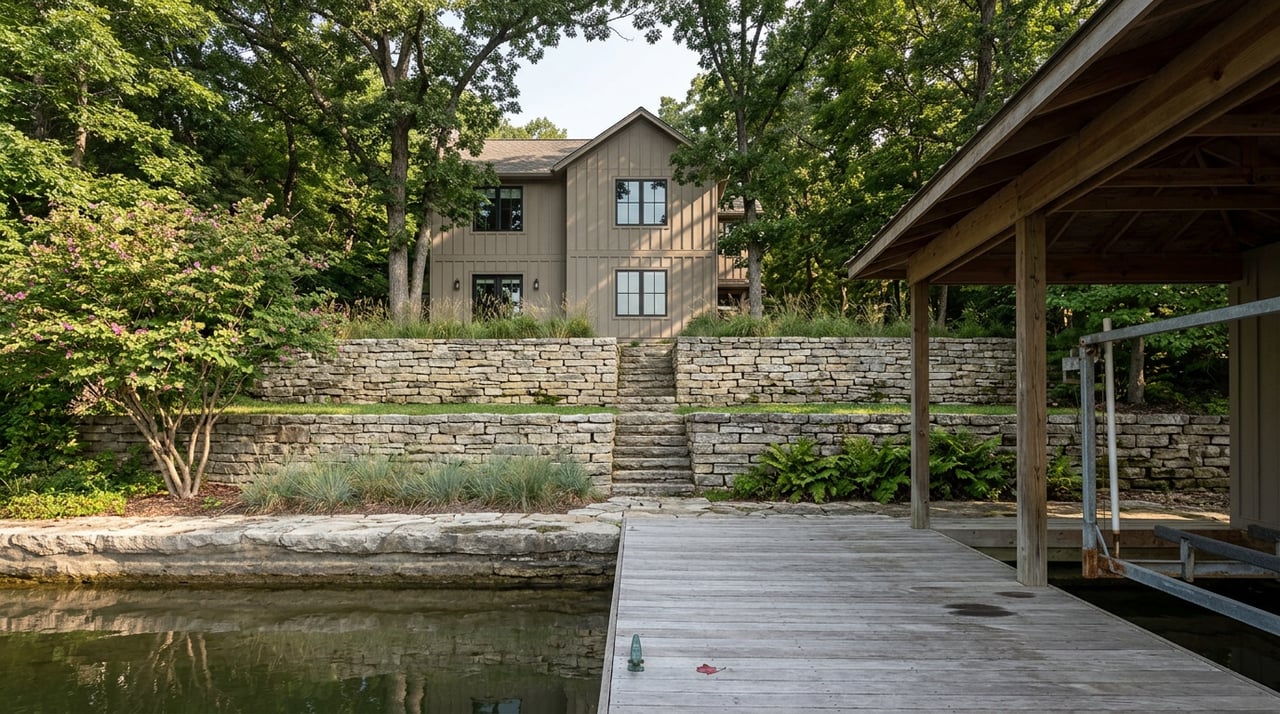
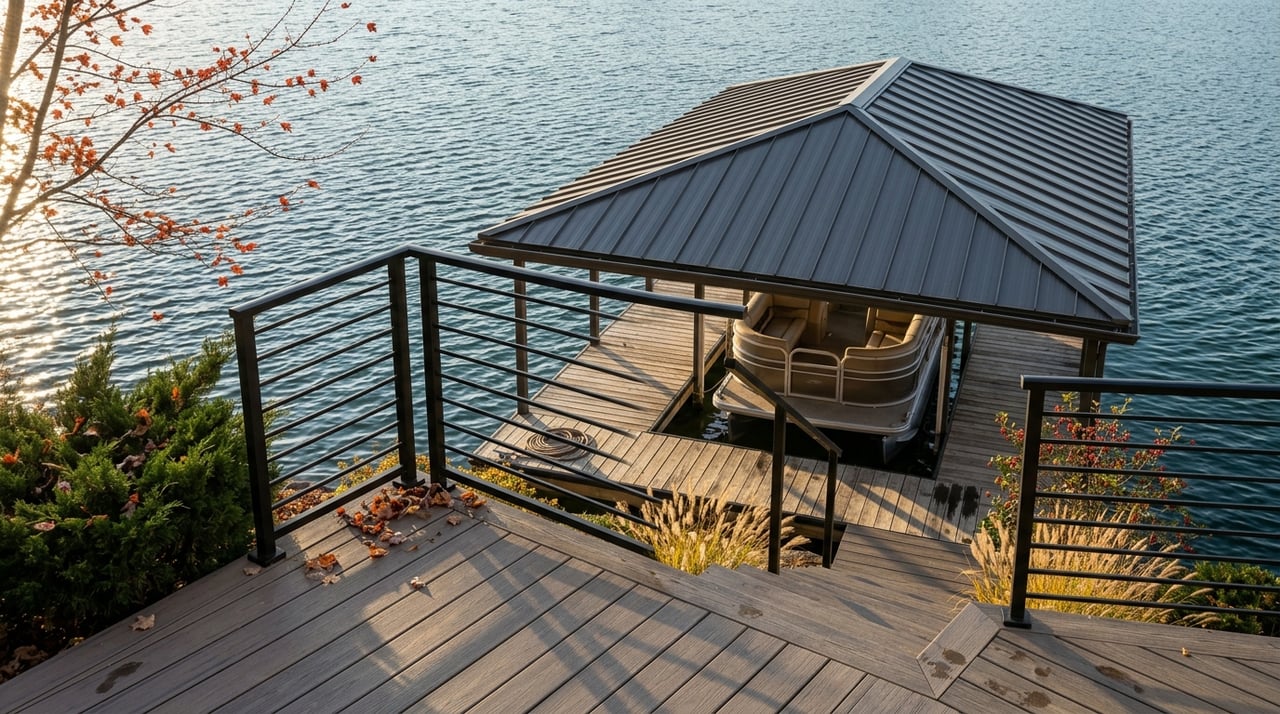
Every fall, a handful of new Lake Ozark buyers get the same unpleasant surprise. They toured the property in July with the water at full pool, boat gassed up, dock floating right where the listing photos promised. They closed in September and moved in feeling like they understood exactly what they bought. Then February comes, the lake drops, and the dock is sitting on exposed mud at an angle nobody showed them during the walkthrough.
That's not a defect. It's Ameren Missouri's winter drawdown doing what it does every year, and it's the variable that no median price, no square footage figure, and no "waterfront" listing tag will ever capture for you.
Ask three different market trackers what a Lake Ozark waterfront home costs right now and you'll get three different answers, and all three will be technically correct. As of June 2026, the median sale price for a lakefront home at Lake of the Ozarks stood at $681,250, up almost 9 percent from June of last year. Look at the full year of 2025 instead and the median settles closer to $625,000, while the average climbs to $801,782, a gap driven largely by a 46 percent jump in sales of $2 million-plus homes that year.
That spread between median and average tells you something real: the luxury tier is pulling the average up while the middle of the market holds fairly steady. But it doesn't tell you why two homes at nearly identical price points, in the same general stretch of lake, can end up worth very different things to the person who actually owns them come January. A recent 707-square-foot condo on Kodiak Lane closed at $216,000 after 85 days on market, while a larger 1,400-square-foot unit on Emerald Bay Street took 133 days to sell at $348,000. Size explains a good chunk of that gap. It doesn't explain why two properties of near-identical size, price, and mile marker can still land in very different places once you factor in whether the dock actually works twelve months a year.
Lake of the Ozarks isn't a natural lake with a fixed shoreline. It's a reservoir behind Bagnell Dam, and Ameren Missouri manages the water level under a Federal Energy Regulatory Commission license that sets a full pool target around 659 to 660 feet of elevation each summer. Every winter, the utility draws that level down, typically to around 654 feet, to create storage capacity ahead of spring rains and to help meet heating-season power demand. That's a six-foot swing in a normal year. In some winters it has gone further, with Ameren warning dock owners to prepare for drops approaching eight and a half feet, and elevation readings as low as 651 feet on record in leaner years.
Six feet doesn't sound like much until you realize it isn't distributed evenly across the lake. Ameren's director of hydro operations said as much in a December 2025 notice to dock owners, explaining that "depths vary so much from cove to cove" that winterizing remains one of the best ways owners can protect their docks. A cove that sits at eight feet of water in July might be down to two feet by February. A main channel position with the same eight feet of summer depth might barely notice the drop at all.
This is why "waterfront" at Lake Ozark isn't one category of property. It's a spectrum, and where a specific home sits on that spectrum matters more to its winter usability than its listing price does.
| Position | Typical depth at full pool | Winter depth risk | Dock condition through drawdown | Fits buyers who want |
|---|---|---|---|---|
| Main channel | Deep, changes little | Low | Usable most winters, more exposed to wake and chop | Big open-water views, don't mind rougher water |
| Protected deep cove | Six to eight feet or more at minimum pool | Low to moderate | Generally floats year-round | Calm water, year-round dock access, quieter setting |
| Shallow cove | Two feet or less at minimum pool | High | Dock may rest on the lake bottom for weeks each winter | Lower entry price, less concerned with off-season access |
A dock resting on the lake floor over the winter isn't automatically a problem. Shelby Burns of Rough Water Docks, a local dock building company, has noted that it's not necessarily bad for a dock to rest on the lake floor, as long as the bottom isn't rocky. But it does mean a boat can't launch from that dock until spring, and it means a family who bought expecting year-round access has a very different property than they thought they closed on.
Main channel positions carry a premium for their views and their consistency, though that consistency comes with higher dock maintenance since rougher water is harder on hardware. Coves trade some of that view for calmer conditions, but only if the specific cove holds real depth at drawdown. Buyers who prioritize a view above all else sometimes go further still and purchase homes on bluffs where a dock isn't feasible at all, accepting no boat access in exchange for elevation and privacy.
Lake of the Ozarks is organized around mile markers rather than street addresses, and that geography carries real pricing logic. The lower mile markers, roughly 1 through 45, are dense with bars, restaurants, and marinas, and homes there command a premium from buyers who want an active, social stretch of water within a short boat ride of dinner. Head toward Lake of the Ozarks State Park or Ha Ha Tonka State Park and the pace slows considerably, with far less inventory but a quieter shoreline.
The Gravois Arm on the north shore is often the most affordable way to buy actual waterfront, and it sits directly across the channel from Six-Mile Cove, historically nicknamed Millionaire's Cove for the estate-level homes that line it. Two buyers can be looking at properties less than a quarter mile apart by water and be shopping in entirely different price tiers. The Village of Four Seasons and Horseshoe Bend lean heavily residential with established condo stock, while Porto Cima, part of that same western stretch of the lake, anchors one of its most consistently premium micro-markets, priced and compared almost entirely against its own recent sales rather than against the broader lake median. Farther east, the Grand Glaize Arm abuts the largely undeveloped Lake of the Ozarks State Park and sits in the middle of the lake's busiest commercial corridor, yet offers a noticeably different feel once you're a few coves off the main channel.
None of this shows up cleanly in a portal search filtered by price and bedroom count. It shows up when someone who knows the water explains why a home three coves apart from a comparable listing is priced the way it is.
A few questions separate buyers who understand what they're purchasing from buyers who find out in February.
Does every cove lose the same amount of depth each winter? No. Deep coves and main channel positions typically hold six to eight feet or more at minimum pool, while shallow coves can drop to two feet or less. The lake-wide six-foot drawdown target is an average, not a guarantee for any single location.
Will the seller already know their dock's minimum-pool depth? Usually not. It's a detail most owners have never formally measured, even after years at the property, which is exactly why it's worth confirming independently before writing an offer.
Is the winter drawdown the same amount every year? Not exactly. Ameren targets roughly 654 feet most winters against a 659 to 660 foot summer full pool, but the guide curve allows for variation based on rainfall and power demand, and some winters have seen levels drop further than that target.
The median price tells you what the lake cost last month. It won't tell you whether the dock you're buying will float in February. If you're comparing specific coves, mile markers, or communities around Lake Ozark and want a read on what a particular property's depth and position actually mean for year-round use, Emily Durgan has spent more than two decades working this shoreline and is glad to walk through it with you. Let's Connect.
Stay up to date on the latest real estate trends.
Bringing deep local insight and a passion for waterfront living, clients are guided through every step with clarity, care, and a focus on finding the right fit.